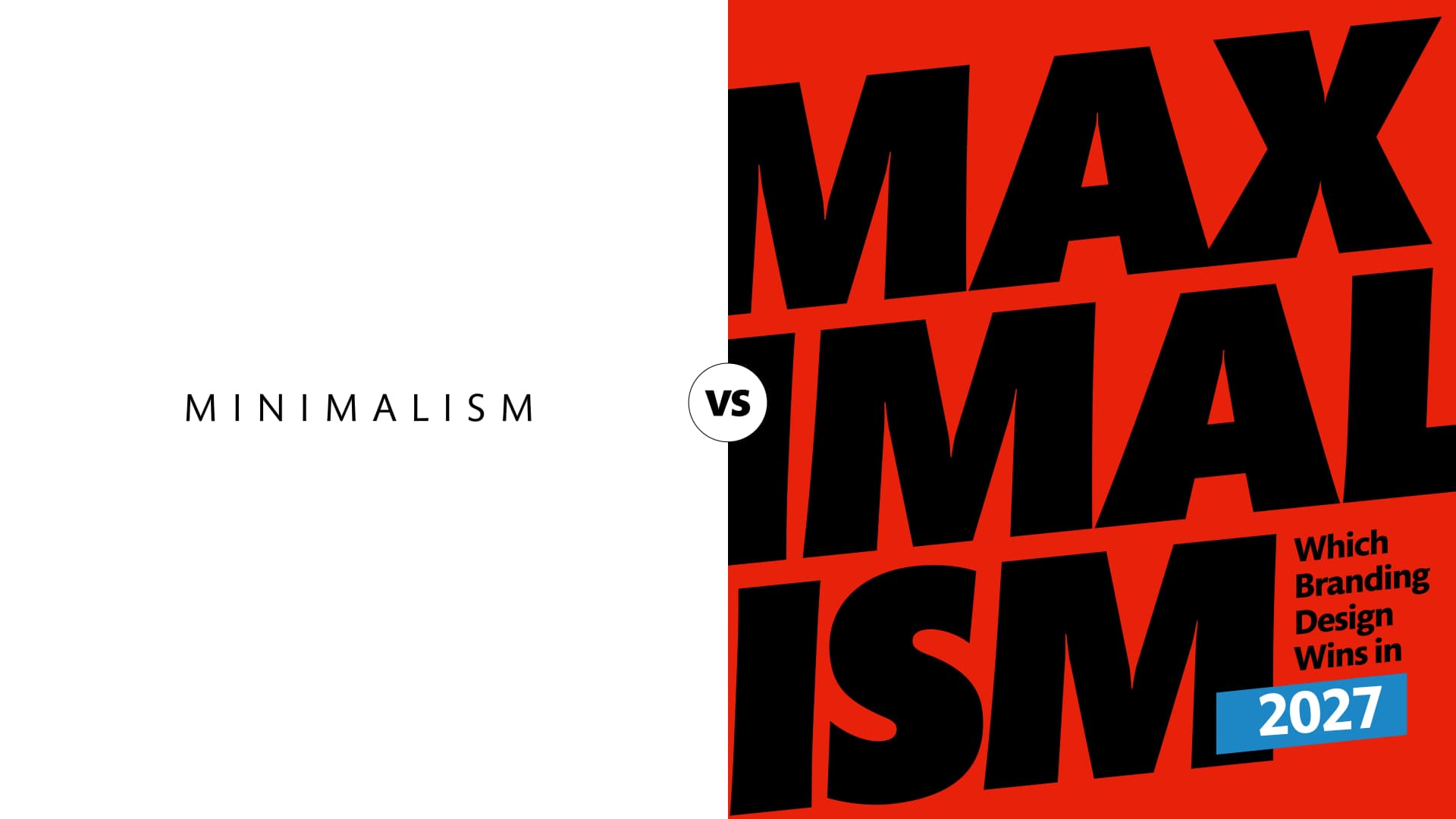
Some brands stand out through simplicity. Others build recognition through bold colours, expressive typography, and layered visuals. Both approaches can work. The difference lies in what the brand needs to communicate.
As visual trends continue to evolve, the debate around minimalism vs maximalism raises an important question: should a brand simplify its identity or embrace a more expressive design language?
The answer depends on the brand’s positioning, audience, industry, and communication goals. Minimalism can bring clarity and consistency, while maximalism can help express personality and create visual distinction. Neither guarantees a stronger brand on its own.
For businesses, the objective is to choose a design direction that communicates the right message and remains relevant beyond a passing trend.
What Is Minimalist and Maximalist Design?

Minimalism and maximalism approach visual communication differently. One relies on restraint, while the other uses visual abundance to express a brand’s character.
What Is Minimalism in Branding?
Minimalism in branding is an approach that uses simplicity to communicate clearly. It often features restrained colour palettes, purposeful typography, clean layouts, and generous negative space.
The idea is to remove unnecessary elements so that the brand’s identity and message remain easy to understand. Every design choice has a role, from the shape of the logo to the way information is organised.
Minimalist branding can be particularly effective for businesses that want to communicate precision, sophistication, or reliability. It also offers flexibility across websites, packaging, signage, advertising, and other brand touchpoints.
However, simplicity alone does not create distinction. Without a recognisable visual idea or a clear brand strategy, minimalist identities can begin to look similar.
What Is Maximalism in Branding?
Maximalism uses visual richness to express a brand’s personality. Bold colour combinations, expressive typography, illustrations, patterns, textures, and layered compositions can all contribute to this approach.
Rather than reducing visual elements, maximalist design uses them to create a more immersive and distinctive identity.
This approach can work well for brands that want to communicate creativity, individuality, energy, or cultural relevance. It gives designers more ways to build a recognisable visual language and tell a brand’s story.
But adding more elements does not automatically make a design more effective. Without a clear hierarchy and consistent design principles, maximalism can become cluttered and make communication harder to follow.
What Is the Difference Between Minimalist and Maximalist Design?
The key difference is how each approach uses visual elements to communicate a brand’s message.
| Factor | Minimalism | Maximalism |
| Design Factor | Simplicity & restraint | Visual richness & expression |
| Colour | Restrained, considered palettes | Bold, varied color combination |
| Typography | Clean & structured | Expressive & attention grabbing |
| Visual Composition | Open layouts & negative space | Layers, patterns, & visual details |
| Brand Impression | Clear, composed, & sophisticated | Energetic, expressive, distinctive |
| Primary Strength | Clarity & consistency | Personality & visual impact |
| Potential Limitation | Can feel generic | Can feel cluttered |
So, what is the difference between minimalist and maximalist branding in practice? Minimalism focuses attention by reducing visual distractions. Maximalism builds attention through a deliberate combination of visual elements.
Both require discipline. The difference is where that discipline is applied: in deciding what to leave out or in deciding how multiple elements work together.
Why Minimalism Still Matters in Branding
A brand often has only a short window to communicate what it offers and why it matters.
A clear visual identity helps audiences recognise the brand without having to process unnecessary information.
This is one reason minimalism remains relevant across industries.
- It Makes Communication Clearer
Simple layouts and clear visual hierarchies help people identify important information quickly.
This is particularly useful for websites, digital products, and communication that requires users to take a specific action.
- It Supports Brand Consistency
A well-defined minimalist identity can adapt across different formats without losing its essential characteristics. Consistent typography, colour, and layout principles help create a recognisable experience across channels.
- It Can Communicate Confidence
Restraint can signal precision and considered decision-making. For brands in sectors such as technology, finance, healthcare, and professional services, this approach may support the qualities they want customers to associate with them.
Where Minimalism Can Fall Short
Minimalist design becomes less effective when it relies too heavily on familiar conventions.
Neutral palettes, simple sans-serif typography, and clean layouts are widely used, which can make differentiation difficult.
The solution is not necessarily to add more elements. It is to develop a stronger visual idea, one that reflects the brand’s positioning rather than simply following an established aesthetic.
Why Maximalism Is Gaining Attention
In visually crowded markets, brands need more than a polished appearance. They need a recognisable personality.
Maximalist design offers a way to express that personality through colour, typography, illustration, imagery, and composition. When these elements work together, they can create a visual identity that is difficult to confuse with another brand.
- It Gives Brands More Room for Expression
Maximalism can help communicate a brand’s character, values, and cultural references through its visual language. This is particularly relevant for brands whose appeal depends on creativity, individuality, or self-expression.
- It Creates Opportunities for Storytelling
Illustrations, patterns, and layered visuals can communicate ideas that a simple logo or colour palette may not convey on its own. These elements can help a brand develop a more distinctive narrative across campaigns and customer touchpoints.
- It Can Improve Visual Recognition
Distinctive visual elements can help audiences identify a brand across digital platforms, packaging, and advertising. The key is to use these elements consistently rather than treating every campaign as an opportunity to create a completely different look.
Where Maximalism Can Fall Short
A visually rich identity needs a clear structure. If every element competes for attention, the main message can become difficult to identify.
Maximalism works best when colour, typography, imagery, and composition follow a defined system. The aim is to create a recognisable identity, not simply a busy one.
Minimalism vs Maximalism in Marketing
The choice between minimalism and maximalism also affects how a brand communicates across its marketing channels.
Minimalism in marketing can help simplify messages, focus attention on key information, and make calls to action more prominent. It can be particularly useful for product pages, service websites, presentations, and campaigns where clarity is a priority.
Maximalist marketing, on the other hand, can help brands communicate energy and personality through bold campaign visuals, expressive headlines, and distinctive creative concepts.
Neither approach is inherently better for engagement or conversions. Their effectiveness depends on the audience, the message, the channel, and how well the design supports the intended action.
For example, a technology company may use a restrained visual system for its website while introducing more expressive graphics in a campaign. A lifestyle brand may use bold colours and illustrations in its advertising while maintaining a simple, easy-to-navigate online store.
The visual approach can change across applications without changing the brand’s underlying identity.
Which Branding Design Wins in 2027?
There is no universal winner in the minimalism vs maximalism debate. The stronger choice is the one that serves the brand’s strategic needs.
Choose Minimalism When Clarity Is the Priority
Minimalism may be the right direction when:
- Your products or services need to be understood quickly.
- Your brand needs to communicate precision, trust, or sophistication.
- Your digital platforms require a clear and intuitive user experience.
- Your identity needs to work consistently across many formats.
Choose Maximalism When Expression Is Central to the Brand
Maximalism may be more suitable when:
- Your brand personality is bold, playful, or expressive.
- Visual storytelling is central to your communication.
- Your category offers an opportunity to stand out through distinctive design.
- Your campaigns need to communicate energy, creativity, or individuality.
Consider a Hybrid Approach
A brand does not have to commit entirely to one style.
A hybrid approach can combine a structured visual identity with selected expressive elements.
For example, a brand might use a simple logo, clear typography, and consistent layouts alongside bold campaign colours, custom illustrations, or distinctive graphic patterns.
This approach allows the brand to remain recognisable while adapting its visual expression to different contexts.
The important consideration is consistency. A hybrid identity should feel like one brand expressed in different ways, not a collection of unrelated design styles.
How to Choose the Right Design Direction for Your Brand
Before choosing between minimalism and maximalism, consider five questions.
1. What does your brand need to communicate?
Define the qualities you want people to associate with your brand. Clarity, sophistication, energy, creativity, and individuality may require different visual approaches.
2. Who are you trying to reach?
Understand your audience’s expectations, preferences, and familiarity with your category. Design decisions should reflect audience insight rather than assumptions about what a particular demographic likes.
3. What does your competitive landscape look like?
Study how competitors present themselves. If the category is dominated by minimalist identities, a more expressive approach may offer an opportunity to differentiate. The reverse may also be true.
4. Where will your identity appear?
Consider how the design will translate across websites, mobile screens, packaging, signage, social media, and other relevant touchpoints. A strong identity needs to function in practice, not just in a presentation.
5. Can the design evolve with your business?
A brand identity should allow room for new products, campaigns, audiences, and business priorities. The objective is to build a flexible system rather than an identity that works only for the current moment.
These considerations help turn a design preference into a more informed branding decision.
Final Verdict
Minimalism and maximalism are two different ways of expressing a brand, not competing formulas for success.
Minimalism can make communication clearer and create a consistent visual system. Maximalism can give a brand a more expressive personality and a distinctive presence. Both can be effective when they are supported by a clear strategy.
In 2027, the focus should not be on choosing the trend that appears most popular. It should be on understanding what your brand needs to communicate and developing an identity that does so effectively.
At Litmus Branding, a best Branding Company the starting point is the brand itself: its positioning, audience, objectives, and place in the market. The visual direction follows from that understanding.
Because the strongest branding is not necessarily the simplest or the boldest. It is the branding that gives people a clear reason to recognise and remember you.
Frequently Asked Questions
Q1. What is the difference between minimalist and maximalist branding?
Ans. Minimalist branding uses restraint, simple layouts, and fewer visual elements to communicate clearly. Maximalist branding uses richer colours, expressive typography, patterns, and layered visuals to communicate personality and create visual impact.
Q2. Is minimalism in branding better than maximalism?
Ans. Neither approach is universally better. Minimalism can support clarity and consistency, while maximalism can help express a distinctive personality. The right choice depends on the brand’s positioning, audience, industry, and communication goals.
Q3. What is minimalism in marketing?
Ans. Minimalism in marketing uses clear layouts, focused messaging, and limited visual distractions to help audiences understand a message and identify the intended action. It can be effective across websites, advertising, and digital campaigns.
Q4. Can a brand combine minimalism and maximalism?
Ans. Yes. A brand can maintain a simple, consistent visual foundation while using expressive colours, illustrations, or typography in selected applications. A clear design system helps keep these variations recognisable as part of the same brand.
Q5. Which branding design trends should businesses follow in 2027?
Ans. Businesses should prioritise design choices that reflect their brand strategy and audience rather than follow trends without a clear purpose. A distinctive, adaptable identity is more valuable than adopting a visual style simply because it is popular.